My goal with my previous sports post (10
International Sports) was to share some new or different sports with you,
as well as get more people interested in said sports. Today's post will try to
do something similar. This will work as an introduction to some hybrid sports,
which I would define as taking the framework of two different sports to combine
them into a single, separate game. I will be trying to share different sports
than what I used in the previous post to go over as many various sports as
possible (cause there's a lot).
My focus will be on sports that feel like their own separate thing rather than just a mesh of two sports. For example, chess boxing (as the name implies) has multiple rounds of guys playing chess before boxing each other and then rinse and repeat. I would only consider putting chess boxing on this list if maybe the boxers were playing wizard's chess while duking it out at the exact same time. This list also excludes sports that are essentially a known sport in a different environment, like Floorball, which is basically indoor hockey with a wiffleball. This list also avoids sports on vehicles like Unicycle Polo or something like that.
First, some older examples of sports that blended rules.
Volata
A shortly lived combination of soccer and rugby. Apparently, the Italian fascists,in the early 20th century, wanted to distance themselves from the English roots of football (soccer). So they developed a substitute for association football and rugby union. In Volata, two teams composed of 8 players each and played on a modified soccer field. The game lasted one hour, divided into three periods of 20 minutes each. Basically the ball could be played by using hands and feet, but for not more than three seconds. Sounds similar to some current variations of football being played today, but we'll get to that in a moment.
Austus
A mix of Aussie Rules Football (see explanatory video here)
and American Football, with the name taken from combining the names of the
countries (AUST...+U.S.). It was only historically played back in WWII and created in Australia when soldiers from
the USA wanted to play football against the Australians.The composite rules
consisted of throwing (which is not allowed in Aussie Rules) and kicking (which
is rarely used in American Football). They used an American Football since it
was designed better for throwing but still a similar shape to the Aussie
football.
Now, some modern examples of blended rules sports.
International
Rules Football

An almost annual
match of Australia versus Ireland that blends Aussie Rules with Gaelic
football. In this match, the players fight over a round ball similarly used in
Gaelic. The games are played on a rectangular field, rather than the larger
oval of Aussie Rules. A player must touch the ball on the ground once every one
meter or six steps. Two bounces per possession are allowed. A free kick will be
awarded if a player commits a foul. The Aussies get to tackle, but only
between the shoulders and thighs, which is otherwise banned in Gaelic football. The
goals are two large posts and two small posts, as in Aussie Rules, though a
crossbar and goal net is incorporated as in Gaelic Football. Passing the ball
in the goal net received 6 points, over the cross bar 3 points, and between a
large post and a small post 1 point.
Composite
Rules (Shinty-Hurling)

Now that those are
explained, time for some contemporary hybrid sports that some people are
playing all over the world today.
Footgolf

Octopush

Padbol

I made a brief mention of this new Argentinian sport in my last sports post. At first it looks similar to sepak takraw, but the walls surrounding the court make a huge difference in game play, like racquetball/ squash compared to tennis. Also, the net is much lower and the court is marked more specifically for when and where players can touch the ball. The ball bounces on the ground and lateral walls, which gives the game continuity and speed, and players have to serve the ball to the space diagonally across from it, like tennis. The players may use their feet, head, chest, and legs to maneuver the ball like soccer.
Fistball

A strange punchy mix of volleyball and tennis. The crucial difference in fistball (compared to volleyball) is that the ball is struck with either fist or arm-never with open hands-and the ball is allowed to bounce after each contact. Today's game has five players per side punching the ball over a ribbon instead of a net, though the ribbon is set at a height similar to volleyball.
Polocrosse

A slightly creative name, given that this sport combines polo with lacrosse. In
England, polocrosse was an indoor exercise to teach people how to ride a horse.
The modern game began in Australia in the 30s. The field can be either grass or
dirt and teams score points by throwing the ball through the opposing goal
posts while protecting their own goals posts. All players can catch, carry, and
throw the ball with their rackets. Since I already talked about Pato before,
which I described as a blend of basketball and polo, I figured this other horse
sport deserved the spot on this list.
Kronum
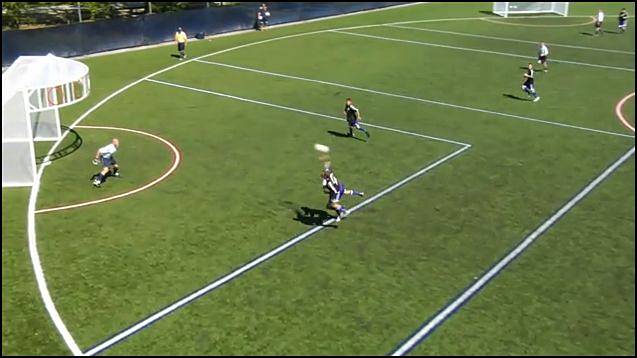
Perhaps the craziest 'sport' on this list. It combines elements of soccer, handball, and basketball. The field consists of three concentric circles, with the outer circle containing the four goals. The front of each goal consists of the Goal Zone, Wedge Zone, Flex Zone, and Long Range Zone, and each zone dictates ball handling and the number of points awarded for scores. The teams are 10 on 10, and each team has two goals to defend. You can’t touch the ball with your hands when you’re in the Wedge Zone, but all parts of your body are legal in all the other zones. No matter where you are, you can only take two steps with the game ball before you have to dribble. If you’re in the Goal Zone and kick the ball into the “chamber” (the goalmouth), that’s 1 point. Dunk the ball in and you get 2 points. From the Wedge Zone, a score into the chamber is worth 2 points. Kick or head the ball into one of the crown rings and your team gets 4 points. From the Flex Zone, a chamber score is worth 3 points, while crown rings are 6 points. Evidently, these are the most common types of scores found in competitive Kronum. Finally, if you’re out in the nether regions of Long Range Zone, a chamber score nabs you 4 points while a crown ring score gets a whopping 8 points.
My
only real complaint against a sport like Kronum is the attitude it has towards
all of the stuff it has going on. Kronum's motto is 'a new sport for the modern
athlete' and was created to allow a full display of human athleticism. I
recently discovered another new sport, Nashball, which also combines elements
of three or four other established sports in order to allow the modern athlete
to display creativity and utilize their entire body. These sports act like
they're the best thing to happen to the sports world ever, but why? Why does
the 'modern athlete' need anything new or special to challenge them, to use
their body and show creative athleticism? Why does the 'modern athlete' need to
play a sport that is really just a hyperactive-overreach of scraps and bits of
multiple other sports that they can already play? Most of these other
sports in this post are new and inventive, but they don't act all cool and hip
for bringing together different sports. They provide challenge and recreation
just by being their own thing, though they acknowledge their roots come from
two other established sports. Some of these sports, like fistball or padbol,
can really be played by athletes of any shape and size. You don't need to know
how to play four other sports or need to be the most in-shape athlete ever in
order to play, which feels like the opposite of the message that Kronum and
Nashball are sending. Overall, I enjoy learning about these sports that have recently been invented or are just new to my knowledge and I hope to be able to participate in each one some day.
Source Websites:
-International Rules: http://www.topendsports
-Composite Rules: http://www.topendsports.
-Footgolf: http://www.footgolf.
-Octopush: http://www.gbuwh.co.uk/?
-Kronum: http://kronumrecleague.

